Archives - Page 3
-
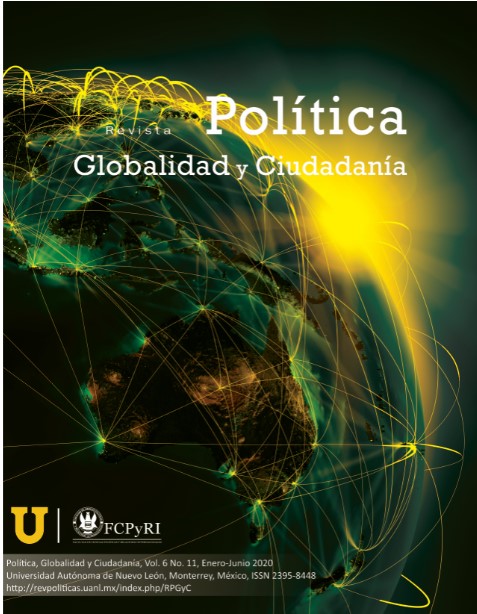
January - June
Vol. 6 No. 11 (2020)This new socio-spatial, dynamic and complex reality raises multiple challenges, readings and valuations around multicultural coexistence and social development in host cities, attracting the interest of social sciences in Latin America, which has resulted in a greater number of research projects, specialization courses, study centers and national and international interregional and transatlantic collaboration that reflect on migration, coexistence and social incorporation. These changes have led to old emigration countries becoming migratory destinations (Spain and Portugal; Mexico), and conversely, old immigration destinations (Venezuela) have become expulsion of immigrants (Gissi, Ghio and Silva, 2019 ), or that they harbor both emigration and immigration, a reality that became evident in the Iberian Peninsula during the last world crisis (Padilla and Ortiz 2012) or in the new migratory context in Latin America (Peru, Colombia, Ecuador, Brazil), in the actuality very marked by the Venezuelan exodus. Inclusively, it has become evident how political and electoral processes increasingly influence immigration.
-
July - December
Vol. 5 No. 10 (2019)Politics, Globality and Citizenship, is presented as a scientific journal whose main objective is to disseminate research results articles that contribute to strengthening the spectrum of scientific knowledge in political science and international relations. For this, the journal's editorial process was restructured, all documents are submitted to arbitration processes under the double-blind modality, the editorial criteria of international publications were included, its ethical policy was adjusted, and editorial practices were improved. , tending that the journal be evaluated and indexed in the different databases that generate impact on a global level.
-
January - June
Vol. 5 No. 9 (2019)Various authors have identified the field of human rights as fertile grounds for interdisciplinary work. A frequent starting point for the study of universal rights is the field of international law (and with that, international relations), yet the focus of this issue is national and thus not primarily concerned with the international aspect of HR. The analysis borrows much from a sociological approach, since the focus is often on “the societal processes and relations that shape and define how human rights are generated, defined and employed in specific social and political arenas”. Besides law and sociology, our interdisciplinary assemble of authors employs perspectives from communication sciences and political science.